Navigate
HomeOverview AboutWhy Nova Trading Contractors & PlumbersTrade rates & referrals ContactVisit or WhatsApp
Products
GI PipesTata & Jindal MS PipesJindal Star & Tata CPVC PipesAshirvad Column PipesBorewell range
Guides
GI vs MSMaterial comparison GI Price GuideHyderabad rates Borewell GuideColumn vs GI CPVC vs PVCPlumbing guide CPVC vs GI vs MSFull comparison
Home Building
House That Lasts 100+ YrsStructure guide Plumbing & ElectricalNew home planning Wall MaterialsAAC vs Clay vs Fly Ash
Send Requirement List

CPVC vs GI vs MS Pipes
Complete Plumbing Guide for Indian Homes

Three pipe materials. Completely different strengths. Use the wrong one in the wrong place and you will pay for it — in repairs, water quality, or replacement within 10 years. This guide settles it clearly.

Plumbing Guide 2026 India · Hyderabad · Telangana

The Quick Answer

If you are building or renovating a home and need to pick pipes, here is the summary — with details in every section below.

Indoor Water Supply
Use CPVC
Ashirvad or ISI-certified brand
  • Hot & cold water — handles up to 93°C
  • Never rusts inside
  • 50+ year lifespan
  • Low bacterial growth
  • Concealed or open installation
View Ashirvad CPVC Prices →
Outdoor, Overhead, Gas
Use GI Pipes
Tata or Jindal brand
  • Exposed outdoor lines
  • Overhead tank connections
  • Gas supply lines
  • Fire-fighting systems
  • Deep borewell casing (500+ ft)
View GI Pipe Stock →
Underground Mains & Industrial
Use MS Pipes
Jindal Star & Tata · ERW IS:1239
  • Underground water mains
  • High-pressure industrial lines
  • Structural pipe applications
  • Where MS-only specifications exist
  • Must be coated/lined for water
View MS Pipe Stock →

Full Comparison: CPVC vs GI vs MS Pipes

Every factor that matters for choosing the right pipe for your application — in one table.

Prices shown are approximate and exclusive of GST. Actual prices vary with weekly steel, polymer markets, and pipe sizes. Confirm on WhatsApp before ordering →
Property CPVC (Ashirvad) GI Pipes (Tata/Jindal) MS Pipes (Jindal Star & Tata)
MaterialChlorinated PVC plasticMild steel + zinc coatingMild steel (no zinc)
Corrosion resistance Fully corrosion-proof Rusts after 8–15 yrs internally Rusts faster — needs coating
Max temperature93°C (hot water lines safe)~60°C (adequate for most use)Up to 400°C (structural limit)
Max pressure1–2.5 MPa (pipe-size dependent)Up to 10 MPaUp to 15 MPa
Lifespan50+ years15–25 years (urban environment)15–20 years (with protection)
Water quality impact Neutral — no taste/odour Metallic taste when aged Rust contamination without lining
Weight Very light — easy to handleHeavyHeaviest
InstallationSolvent cement jointing — fastThreading and coupling — slowWelding or threading — slowest
Cost (½ inch, per metre)₹90–130₹110–160₹85–140
Earthquake resistance Flexible — absorbs movementRigid — joint stress at bendsRigid — joint stress at bends
UV resistance Needs protection if exposed to sun Unaffected by UV Unaffected by UV
ISI / BIS standardIS 15778IS 1239IS 3589 / IS 1239
Best applicationIndoor water supplyOutdoor, overhead, gas, fireUnderground mains, industrial

CPVC Pipes — The Indoor Standard

CPVC — Chlorinated Polyvinyl Chloride — is the result of an additional chlorination step that gives regular PVC the ability to handle hot water and higher pressures. For Indian homes, it is the clear recommendation for all internal water supply lines.

Why CPVC Replaced GI Indoors
  • No internal corrosion: GI pipes rust from the inside over 8–15 years. The rust flakes break off and contaminate water — and reduce internal diameter, causing pressure loss.
  • Hot water compatibility: GI pipes can be used for hot water but expand and contract with temperature cycles, stressing threaded joints. CPVC handles thermal cycling without joint failure.
  • 50% lower installation labour: Solvent cement joints take minutes. GI threading and coupling takes significantly longer and requires more skilled labour.
  • Hygienic: The smooth inner bore of CPVC discourages biofilm growth. GI's roughening rust surface promotes bacterial adhesion.
  • Lighter: CPVC weighs 1/6th of GI — critical for concealed pipe runs in slabs and walls where extra weight is undesirable.
What to Look for When Buying CPVC
  • ISI mark (IS 15778): Mandatory. Confirms the compound meets BIS specification for domestic water supply.
  • Brand: Ashirvad (Aliaxis Group), Astral, Finolex are consistently recommended. Avoid unbranded or market-only pipes without ISI marks.
  • Solvent cement brand match: Use the pipe manufacturer's own solvent cement. Cross-brand solvent cement can result in weak joints.
  • SDR (Standard Dimension Ratio): SDR 11 (ASTM F441) is the standard for domestic supply — thicker wall for higher pressure capacity.
  • Not for drainage: CPVC is only for supply lines. Use UPVC for drain lines (waste, soil stacks, overflow).
  • Not for direct UV exposure: Cover any exposed outdoor CPVC with paint or sleeve — UV causes surface degradation over time.
Available at Nova Trading
Ashirvad CPVC — ½" to 2" · All fittings in stock
View Stock & Prices →
Use CPVC For All indoor hot and cold water supply lines — bathroom supply (shower, washbasin, toilet cistern), kitchen water lines, solar water heater connections (hot side), water purifier connections, concealed pipe runs inside walls and slabs, all pipe runs inside inspection shafts.
Do NOT Use CPVC For Drainage and waste pipes (use UPVC), gas lines (use only approved black MS or GI gas pipes), outdoor lines directly exposed to harsh UV (cover or use GI), borewell column pipes (use Ashirvad UPVC column pipes), fire-fighting systems where metal is specified by local regulations.

GI Pipes — Still Relevant, Used Correctly

GI (Galvanised Iron) pipes are not obsolete. They are the correct choice for specific applications where their mechanical strength, rigidity, and metal properties are necessary.

What GI Pipes Are

GI pipes are mild steel pipes coated with a layer of zinc (galvanising) to resist corrosion. The zinc sacrificially corrodes in place of the steel, extending pipe life. In urban Indian environments with municipal water (which can be mildly acidic or contain chlorine), the zinc coating lasts 8–20 years depending on water quality. After this, internal rusting begins.

They are supplied in IS 1239 (Light / Medium / Heavy class) and IS 3589 grades. For domestic water supply, Medium class (B class) is the standard. For fire-fighting and heavy-duty, Heavy class (C class) is used.

Tata vs Jindal GI Pipes

Both Tata and Jindal are ISI-certified manufacturers with consistent quality. The choice between them is typically one of availability and price at your local supplier. Both meet IS 1239 specifications.

  • Tata GI Pipes: Excellent brand recognition, widespread availability. Slightly premium pricing in some markets.
  • Jindal GI Pipes: Strong in Telangana and Andhra markets. Competitive pricing with equivalent quality.
  • Avoid: Unbranded GI pipes without ISI marks — galvanising quality is inconsistent, leading to much faster internal rusting.
At Nova Trading
Both Tata and Jindal GI — ½" to 4" in stock
View GI Pipe Sizes & Prices →
Use GI Pipes For Exposed outdoor water lines (terrace, compound wall taps, garden taps), overhead water tank inlet/outlet connections, gas supply lines (mandatory for domestic LPG and PNG connections), fire-fighting risers and sprinkler systems (metal pipe often required by fire code), deep borewell column casing (500+ ft where UPVC column weight is excessive), industrial process piping.
Where GI Pipes Create Problems Concealed indoor supply lines (rusting is invisible until severe), solar water heater connections (repeated thermal cycling stresses threaded joints — use copper or CPVC instead), any application requiring 30+ years without maintenance.

MS Pipes — Heavy Duty, Specific Applications

MS (Mild Steel) ERW (Electric Resistance Welded) pipes are the heaviest duty option in residential and commercial construction. They are not corrosion-resistant on their own, but they offer the highest pressure ratings and structural strength.

What MS Pipes Are

MS pipes are plain mild steel pipes without any corrosion-protection coating. They are sold as IS 3589 or IS 1239 (Heavy grade). For water applications, they must be coated internally (bituminous lining or epoxy) and externally (bituminous paint + wrapping for underground). Without protection, they rust rapidly in contact with water or moist soil.

  • Handles the highest pressures of all pipe materials
  • Can be welded — no reliance on threaded joints
  • Available in very large diameters for municipal and industrial use
  • Lower raw material cost per kg than GI
  • Must always be protected — bare MS pipe in water fails fast
MS Pipe Applications in Home Construction
  • Underground water mains: From borewell/sump to overhead tank, when the line is buried and HDPE is not used. Must be coated and wrapped.
  • Sump internal pipes: Suction and outlet pipes inside the underground sump where they are always submerged (bitumen-coated)
  • Structural pipe columns: MS pipes used as structural columns in parking areas, boundary walls, and pergolas
  • Deep well casing: In some deep industrial borewells where extreme casing strength is required
  • Industrial process: High-pressure steam, compressed air, hydraulic lines in factories
View MS Pipe Stock →

What Pipe to Use — Application by Application

A room-by-room and application-by-application guide for every situation in a typical Indian home.

ApplicationRecommended PipeGrade / SizeReason
Bathroom — shower, basin hot waterAshirvad CPVC½" or ¾"Hot water safe, no corrosion
Bathroom — toilet cistern (cold)Ashirvad CPVC or UPVC½"Cost effective for cold-only
Kitchen — water supply lineAshirvad CPVC½" or ¾"Food-contact safe, hot water
Solar water heater pipingCPVC (hot side) / CPVC (cold)¾" or 1"Up to 93°C without joint failure
Overhead tank connectionsGI — Tata/Jindal1" or 1½"Supports tank weight, UV-stable
Terrace exposed water linesGI — Tata/Jindal¾" to 1½"UV and weather resistant
Gas supply (PNG / LPG)GI — Medium Class (IS 1239)½" or ¾"Metal pipe mandatory for gas
Underground water main (short)GI — Medium Class1" to 2"Buried, shorter runs
Underground water main (long)HDPE or MS (coated)1" to 3"Flexibility, long runs, no joints
Borewell column pipe (0–300 ft)Ashirvad UPVC Column Pipe4" — 20G or 19GLightweight, no rust, easy removal
Borewell column pipe (300–500 ft)Ashirvad UPVC Column Pipe4" — 19G (Light)Max strength UPVC grade
Borewell column pipe (500+ ft)GI Pipe4" HeavyColumn weight requires metal
Drain / soil / waste stacksUPVC (SWR)75mm to 160mmPurpose-designed for drainage
Structural column / pillarMS ERW — Jindal Star / TataAs per designStructural — not water use
Fire-fighting riserGI Heavy Class (IS 1239 C)As per system designFire code requires metal pipe

Cost Comparison — What Does It Actually Cost?

Material cost is only part of the equation. Labour, lifespan, and the cost of repairs when things go wrong all factor into the true total cost of ownership.

Prices are indicative and vary with market conditions and pipe size. Confirm with Nova Trading before ordering.
Pipe TypeMaterial Cost (approx)Labour CostLifespan20-Year TCO (vs CPVC)
CPVC (Ashirvad) ½"₹90–130/m₹35–50/m50+ yearsLowest — no mid-life replacement
GI Pipe (Tata) ½"₹110–160/m₹55–80/m (threading)15–25 years20–30% higher — one replacement likely
MS Pipe ½"₹85–140/m₹70–100/m (welding)15–20 yearsHighest — coating, replacement, repairs
The Cost Reality of GI Pipe Inside Walls

Many homebuilders save ₹15,000–30,000 by using GI instead of CPVC for concealed indoor plumbing. After 12–15 years, the GI rusts internally, reducing water pressure and contaminating the supply. Replacing a concealed GI pipe network in a finished home means breaking tiles, chipping plaster, cutting through concrete — and then redoing all of it. The repair cost is typically ₹80,000–3,00,000 and months of inconvenience. The original CPVC savings of ₹15,000 becomes a ₹2,00,000 liability.

When GI Pipe Is Actually the Right Choice

GI pipe is not the wrong choice — it is the right choice in the right place. For outdoor exposed lines, overhead tanks, and gas supply, GI's rigidity, UV resistance, and metal properties make it the correct specification. The problem is only when GI is used as a cost-cutting substitute for CPVC in concealed indoor supply lines — where it has clear disadvantages and higher long-term cost.

Frequently Asked Questions

Can I mix CPVC and GI pipes in my plumbing system?
Yes — and this is actually the correct approach for most homes. Use CPVC for all indoor concealed supply lines (bathroom and kitchen water supply). Use GI for outdoor exposed lines, overhead tank connections, and gas lines. Use transition fittings (brass or CPVC-to-GI adaptors) at the junction between the two. This is a common and well-tested combination in Indian residential construction.
Is GI pipe safe for drinking water?
New GI pipe is generally safe for drinking water. The zinc coating meets drinking water standards. However, as GI pipe ages (after 10–15 years in urban environments with treated water), internal rusting begins. At this point, the water can carry rust particles and have a metallic taste. This is why GI is no longer recommended for concealed indoor drinking water lines — where early replacement is costly — while CPVC, which does not corrode, is preferred.
What is the difference between GI and MS pipes?
Both GI and MS pipes are made from mild steel, but GI pipe has a zinc coating (galvanising) applied after manufacturing. This zinc layer protects the steel from corrosion, making GI suitable for water supply and outdoor exposure. MS pipe has no such coating — it is bare steel. MS pipe must be externally coated with bituminous paint and wrapped before burial, and internally coated for water contact. Without protection, MS pipe rusts much faster than GI. In return, MS pipe is marginally cheaper, can be welded easily, and is available in larger diameters. For a detailed comparison, see our GI vs MS Pipes guide.
How long does Ashirvad CPVC pipe last?
Ashirvad CPVC pipes are rated for a service life of 50+ years for domestic water supply at standard temperatures and pressures. The company provides a 10-year product warranty, but properly installed CPVC systems in India routinely last 40–60 years without replacement. The main cause of early failure is installation error — using wrong solvent cement, insufficient cure time before pressure testing, or not providing adequate expansion allowance for long runs.
Which is cheaper — CPVC or GI pipes?
On a pure material cost basis, GI and CPVC are comparable — GI is sometimes marginally more expensive per metre in the ½" to 1" range. However, CPVC installation is significantly faster (solvent cement vs threading), so total installed cost (material + labour) for CPVC is typically 10–20% lower than GI for the same pipe network. Over 20+ years, CPVC is substantially cheaper because it does not need replacement, while GI concealed pipework will require replacement in 12–20 years.
Which pipe is best for a borewell in Hyderabad?
For 95% of borewells in Hyderabad and Telangana, Ashirvad UPVC Column Pipe (20G for 100–250 ft, 19G for 250–500 ft) is the recommended choice. UPVC column pipes don't rust, are lightweight (easy to remove for pump maintenance), come with sockets included, and last 20–30 years. For very deep borewells beyond 500 ft, where cumulative pipe weight becomes an engineering concern, GI pipe (Medium or Heavy class) is the practical alternative. Read our full borewell pipe guide for depth-specific recommendations.

Need Help Choosing the Right Pipe?

Talk to Abhay at Nova Trading — CPVC · GI · MS · Column Pipes — all in stock at Secunderabad

Old Ghasmandi, Ranigunj, Secunderabad 500003 · +91 91009 29245

Ask Abhay on WhatsApp View All Products
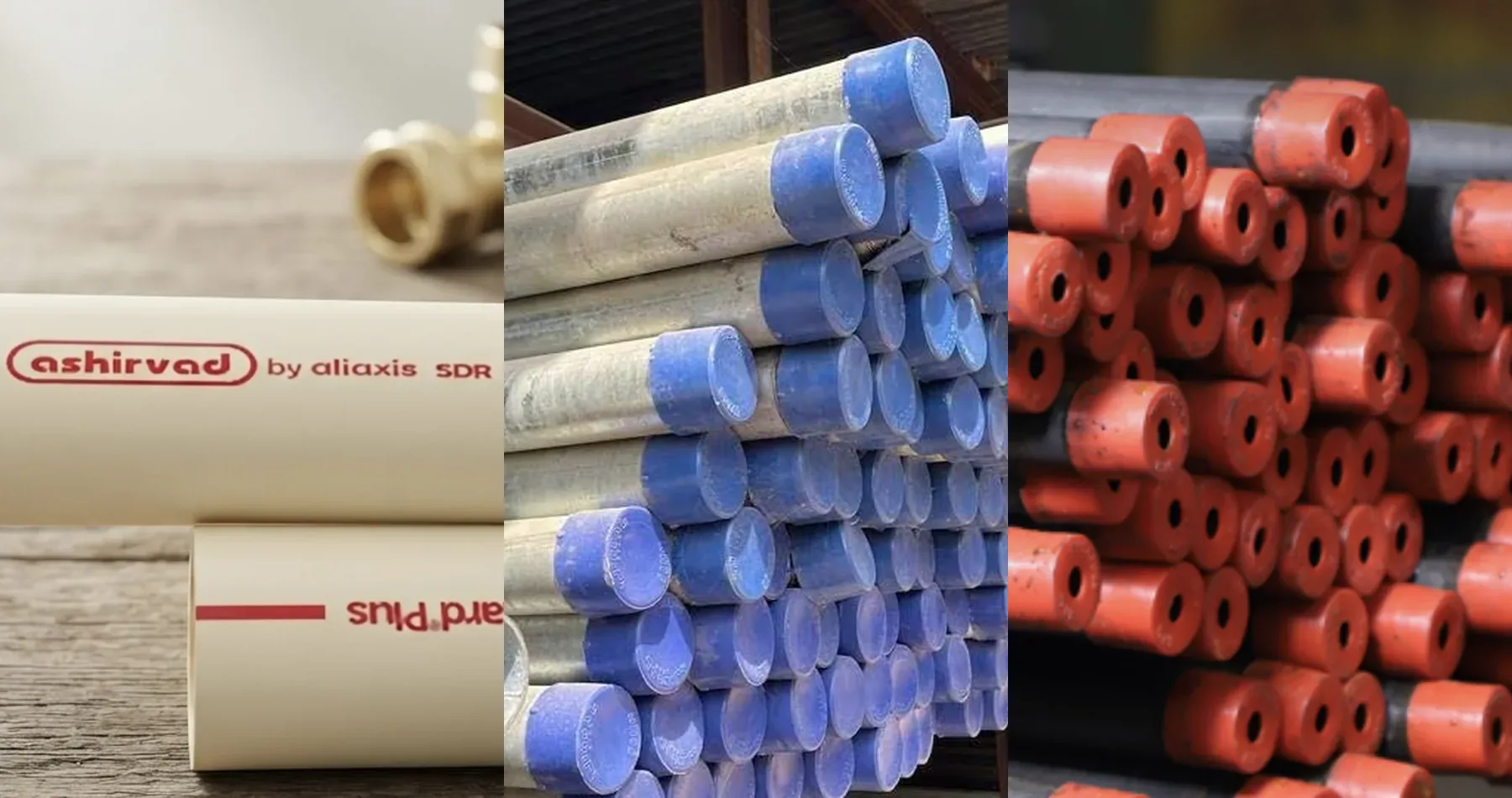
CPVC, GI and MS pipes side by side
Three MaterialsCPVC, GI and MS — each suited to a different job in the same house.

Related Products & Guides

Buy Now
CPVC Pipes — Ashirvad
Hot & cold indoor water supply →
Buy Now
GI Pipes — Tata & Jindal
All sizes · Outdoor & overhead use →
Buy Now
MS Pipes — Jindal Star & Tata
Underground & industrial use →
Buy Now
Column Pipes — UPVC Borewell
4", 5", 6" · All gauges →
Related Guide
Best Pipe for Borewell
UPVC vs GI — depth guide →
Related Guide
Build a House That Lasts 100 Years
Structure, waterproofing, plumbing →